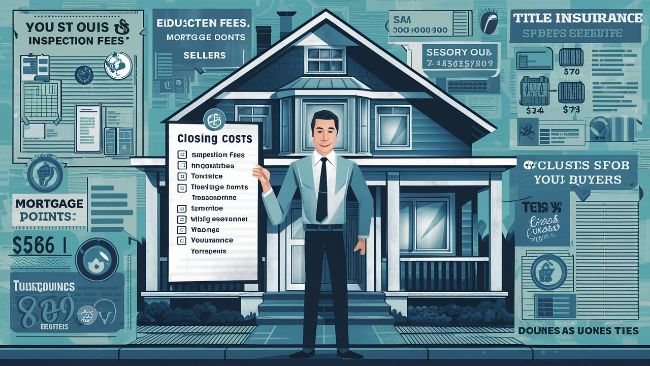
You are about to waterski over the costs of closing these costs so that you can make the best financial decisions possible. You will understand the costs that sellers and buyers will have to bear. You will understand the theoretical and practical dimensions of selling a house.
You will see what parameters, like mortgage pre-approval, are the most relevant. You will also understand how long selling a house takes, what costs are negotiable, and how to avoid the surprises of closing.
When navigating today’s housing market, buyers are increasingly drawn to properties with smart home features and eco-friendly upgrades. Understanding local market shifts and emerging real estate trends can help both investors and first-time buyers make confident decisions while avoiding costly mistakes.
What Are Closing Costs?
As a buyer and a seller, there are closing costs that each of you will bear that are associated with the purchase of a house. These fees span a wide range of legal and service requirements and are consolidated to a particular closing date which is the date that the ownership of the property is transferred.
These costs include:
- Buyer’s lender fees
- Title search and insurance
- Costs associated with appraisal, inspection, and surveys
- Agent commissions in real estate (mostly sellers, but not only)
- Taxes associated with, and fees for, transferring and recording
- Insurance and tax prepayments
Though it is not possible to avoid all closing costs, they are still manageable. The more you understand them, the easier it will be to set a financial plan.
Why Closing Costs Should Be Understood Beforehand
You aim to avoid being blind sided. Closing costs that are severely underestimated can ruin your financial plan. It is advisable to understand closing costs details before making a commitment.
This is the reasons why uncovering information early is beneficial.
- Value your time: Gain insight on how much time selling a company can help.
- Negotiation: You can negotiate with a seller to help you pay some costs.
- Costing: As a lender or agent, you only acquire the basic selling price.
- Schedule: Understanding how long to sell a house helps to streamline inspection, appraisal, and closing schedules.
Including closing costs, how much do you expect to pay?
| Party | Typical Percentage of Sale Price | Example (for a $300,000 house) |
|---|---|---|
| Buyer closing costs | 3% to 6% of the loan/purchase price. | $9,000-$18,000 |
| Seller closing costs | 8% to 10% of sale price, mostly real estate commission + other fees. | $24,000-$30,000 |
The closing costs lowest floating clauses are less than 1-2%. Others are floating, are Washington D. C. for having some of the highest.
What Buyers Pay: Detailed Breakdown
You, being the buyer, wil be closing many closing costs. Outlined below are the majority of the closing costs you will pay.
Loan-Costs
- Application fee: The cost of processing your application.
- Origination fee: For issuing your loan.
- Underwriting / processing fee: For evaluating your loan application.
- Credit report fee: For evaluating your payment history.
Property and Title Costs
- Appraisal fee: Independent evaluation of a house.
- Inspection fee: Ensuring that the structural and functional components of a system work.
- Survey fee: Establishes the boundaries of the property (if applicable).
- Title search & Title insurance: To make sure there are no liens and other legal claims.
Prepaid and Other Costs
- Prepaid taxes and insurance: Closing portion
- Escrow/ settlement fee: Closing payment that a lawyer or agent receives.
- Filing fee: To the local authority for the registration of the deed.
- Survey, flood clearance for, & the HOA (if applicable).
Optional / Negotiable Costs
Discount Points: You can pay points to lower your interest rate.
Seller Concessions: You can ask the seller to pay a portion, or the entire amount, of your closing costs.
Mortgage Pre-Approval: While not very expensive, it does allow you to compare lenders, and helps you anticipate other costs associated with the loan.

For sellers and investors, it’s important to master the basics of property flipping and strategies for maximizing rental ROI. Knowing how sustainable real estate gains value, planning for closing costs, and even learning how to sell a home by owner can make all the difference in achieving long-term success.
What Sellers Pay: Detailed Breakdown
For you, the seller, there are also closing costs, which tend to run higher. Here are some costs to consider:
- Real estate agent commission: Biggest chunk. Typically 5-6% or more. (Zillow2)
- Transfer taxes: Varies by state/ municipality.
- Title insurance (buyer sometimes, seller other times).
- Escrow / settlement fees for closing agent.
- Prorated property taxes: You pay up to day of closing.
- HOA dues, utility bill reconciliations: Charges paid in advance or amount due.
- Legal costs (where applicable in the local market).
From Mortgage Pre-Approval To Closing: Step-by-Step Guide
Once you want to buy/sell, these steps will get you delaigned.
Getting Mortgage Pre-Approval
You will submit your assets, income, and credit to a lender and get a general idea of borrowing limits. Explanation of purchase terms will be easier with a pre-approval.
Putting a Price/Offer
As you, submit the offer, it is easier to utilize pre-approval in order to prove your seriousness. When you are the seller, you need to determine the price to be able to cover sale costs.
Completing for negotiation
You discuss the price and argue about which costs each of the buyers and sellers will cover. Clarify who pays which closing costs.
Home inspection and appraisal
Buyers pay for the inspections and the other side pays for the appraisal. For these, you need to pay a certain fee.
Loan Processing
While the loan is being processed your mortgage lender is underwriting the loan. This will give you a loan estimate for closing costs provided within three days of the application in the United States.
Review and modification
Keep the closing document for a couple of days to view the closing costs and changes you need.
Closing Day
You will pay your part of the closing costs and sign the necessary documents. The proceeds from the closing costs will cover the seller’s part. Ownership is given to you.
After Closing
You will be given the title. The seller will receive payment. There may be reminders that follow: insurance, mortgage payments, and property tax that are due.
How Long Does It Take to Sell a House (and How That Affects Costs)
When discussing closing costs, one has to consider the timeline as well. The costs associated with selling a house are impacted in various ways depending on the duration of the selling period.
Time on the market: If your house sleeps on the market, the chances are high that you are spending high in mortgage, maintenance, and utilities.
Negotiations: If the period is longer, buyers are likely to leverage more. This usually costs you more as seller concessions.
Scheduling delays: Appraisals, inspections, and title work can take days and even weeks.
The duration between listing and closing is usually between 45 and 90 days in the majority of the US markets. The duration is a lot less in cases where the buyers are not using a mortgage or when everything is ready to go. You can speed the process up by securing mortgage pre-approval well in advance, getting your inspections done, and the rest of processes being organized.

How Mortgage Pre-Approval Can Lower Your Closing Costs
More often than not getting pre-approval is a lot more important than people think. This is how pre-approval helps you save;
- Buyers not get surprised by the appraisal process. This is due to the fact that you will know the amount you can borrow.
- With pre-approved buyers, lenders tend to work quicker. This reduces the chances of delays which is most favorable.
- You can shop lenders, more like picking a lender with the most favorable closing cost, and relatively low fees.
- Certainly, pre-approval is a sign of seriousness. Sellers are likely to offer more favorable terms, like reducing closing costs.
Real Life Example / Case Study
To illustrate: You decide to purchase a house for $350,000 in a state where the buyers’ closing costs average 4% of the selling price, and the sellers’ closing costs average 9%.
- Estimate the closing costs for the buyer: $350,000 x 0.04 = $14,000.
- Estimate the closing costs for the seller: $350,000 x 0.09 = $31,500 (mostly for commission).
You as the buyer, found a lender who has lower underwriting fees and requested that the seller pay $2,000 towards the closing fees. You final consider the closing costs to be $12,000.
The seller also priced the home at $360,000, anticipating these closing costs, but because of the market, the price had to be adjusted to $350,000. Net effective proceeds to the seller is: $350,000 – $31,500 = $318,500.
This case illustrates how negotiation, local market knowledge, and understanding if you are in a buyer’s or seller’s market can change the deals a lot.
Pros and cons of who pays what costs
The table below showing for you to consider buyer vs seller obligations for closing costs is in pros and cons format.
| Who Pays | Pros | Cons |
|---|---|---|
| Buyer pays most closing costs |
|
|
| Seller pays most closing costs |
|
|
Expert Insights & Statistics
You want reliable data. Here are authoritative sources and figures.
- Buyer closing costs in America are usually 3%-6% of the loan based on the estimates of Rocket Mortgage.
- Closing Corp data (via Bank rate) indicates that for a single-family home, average closing costs (including taxes) are about $6,900 in many markets.
- Sellers have for years paid 8%-10% of the selling price in closing costs, including real estate commission.
These figures change with:
- Local laws (transfer taxes, fees)
- Home value
- Whether you are in a buyer or seller market
How to Reduce Your Closing Costs
You can take action. Here are concrete tips.
- Look for several lenders and check fees for origination, underwriting, and application.
- Talk to the seller for concessions on some financing costs.
- Sometimes title companies or attorneys offer lower combined rates when their services are bundled.
- Avoid unnecessary extras like, expedite title searches and extra inspections.
- Different loan types like conventional and FHA have varying seller contributions.
With these, the chances of surprises on closing day goes down.
Regional Variation & Legal / Tax Matters
As with other expenses, you should research your region, as laws and tax regulations can be closing cost killers.
- Some charge exorbitant transfer or property taxes. Some jurisdictions utterly devoid of such tax burdens exist.
- Some places mandate lawyer attendance; other places allow title agents to handle such work.
- Local or municipal charges such as record keeping, examination, and permitting differ.
You can get essential information from local government or a real estate association. A lot of state government or ‘gov’ real estate commission websites in the US break down specific charge structures. Other countries can approach their designated real estate regulatory bodies.
The Steps to Selling a House and Closing Costs
Selling a house, for any reason, involves several actionable steps, and closing costs is one such step which is intertwined with the other steps in the process. Here is a simple path for sellers, where closing costs are sighted:
- Home sale preparation (repairs, staging, etc. for the home for sale)
- Listing the house with an agent
- Receiving the offer and the negotiations (you negotiate the price and who pays the closing cost)
- Final accept of the offer
- The buyer conducts an appraisal and an inspection
- Completion of the closing: payment of all closing costs, agent commissions, transfer tax
Being knowledgeable of this creates a sense of urgency to plan right, such the costs are easily manageable and not a shock at the end.
Pros & Cons of Big Closing Costs
With respect to the closing costs being particularly high, here is confirms pros and cons.
Pros:
- There is a more secure deal ( legal and title insurance work).
- There will always be inspections and appraisals to curb a poor purchase.
- There are agents to offer marketing and negotiating and other value added services to streamline the process.
Cons:
- The closing costs being particularly high will be a disincentive and hence the rest of the props costs borne by the buyer is high.
- The sellers ability to increase profitability is constrained to the extent of the costs surrounding commission and other fees.
- There is always the risk of unforeseen costs or expenses that have not been explained thoroughly and hence not analyzed.
What Happens when There is No Budget Plan for Closing Costs
There are some possible outcomes:
- There could be an insufficiency of funds at closing that could stagnate the whole process or derail the entire transaction.
- The delays could be counteracted by charging a fine or changing the payment terms.
- There is a chance that you might get stuck with the increased interest loan or the less preferable option if you are given the roll option.
- Considering all of the above, it is vital to start planning at the soonest possible times.
Pre-Approved Mortgages & Closing Costs Case Study
There are times that the mortgage pre-approval is a game changer.
You want to buy a property that is worth $400,000 and you are pre approved for a mortgage. You concurrently apply to 3 lenders. Lender A says 5%, Lender B says, Closing costs are 3.5%, and Lender C says 4.2%.
You go with Lender B, and you have saved 6,000 dollars vs payment A. Also, you get to show the Pre-Approval and the seller is willing to contribute 1,500 dollars of the closing costs.
This brings the final closing costs to 400,000 ×3.5%, which equals to 14,000 then we take away 1,500 and we are left to 12,500.
Without the pre approval, you will most probably go with Lender A and you will have to pay the whole 20,000 dollars, or the chance that you have to pay working with a less advantageous deal.
Checklist: What You Should Do (Buyer & Seller)
Use this checklist to stay ahead. Your selections will persist in this browser.
-
Apply to lender and obtain written pre-approval to strengthen offers.
-
Request and compare the documents to anticipate final costs.
-
Get at least three written estimates and compare fees and services.
-
Negotiate contributions toward closing costs during offer stage.
-
Scrutinize every line on the Loan Estimate and Closing Disclosure.
-
Consult local government resources for transfer taxes and recording fees.
-
Build buffer time for inspections, appraisals, and title work to avoid rush fees.
-
Arrange certified funds or wire transfers and confirm amounts before closing.
Resource Intern
For more detailed specific instructions on negotiating and understanding the local market, check my Guide Proper Guide.
Summary: Main Takeaways
- Closing costs include many fees. Buyers and sellers share responsibility.
- Buyers usually pay 3-6% of sale/loan amount. Sellers often pay 8-10% including agent commissions.
- Mortgage pre-approval helps you negotiate, budget, and avoid surprises.
- Regional laws and local taxes can change amounts dramatically. Always check with your local jurisdiction or agent.
- You can reduce closing costs by comparing lenders, negotiating, asking for seller help, reviewing estimates.
About This Section
Following you will find 5 answers that help the client easily understand the subject.
What does “closing costs” entail for buyers?
Will the seller cover any costs involved in closing for buyers?
How does the timing in sale of a house impact closing costs?
Does mortgage pre-approval help in lowering closing costs?
Are closing costs tax deductible?
What is a reasonable method for predicting closing costs in advance?

Finishing Remarks
I trust that all of my closing costs explanations. I believe you have understood the costs that buyers and sellers pay and the general closing costs. You understood the impact of mortgage pre-approval. You understood the importance of how long does it take to sell a house. You can follow the steps of selling a house and have an idea on how every step works.
If you wish to learn more advanced topics, I recommend researching the closing cost rules and case studies for your area. You can also investigate the correlation between interest rates and the cost of acquiring a mortgage.