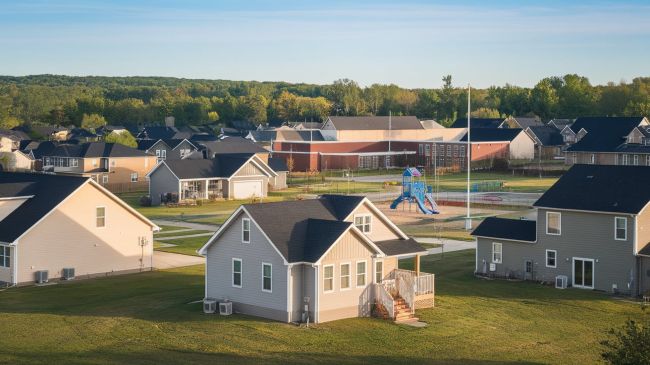
Any time the thought of a house in the U.S enters the mind, the first thought that comes to mind is that old saying, “location, location, location.” But the truth is, location is much more than just highways, shopping centers, or crime stats. A large portion of it comes down to schools.
It’s not just families with children that care. Even single buyers, investors, retirees, and couples with no children at all all look at schools when making a move. Why? Because Schools anchor and determine propter values. A good school district can have your property price sky high, and a poor one can have a struggling property.
Now let’s discuss how much schools really do determine one’s house price in the U.S, and look at the data and examples to prove it.
When navigating today’s housing market, buyers are increasingly drawn to properties with smart home features and eco-friendly upgrades. Understanding local market shifts and emerging real estate trends can help both investors and first-time buyers make confident decisions while avoiding costly mistakes.
Why Schools Matter So Much
Consider this scenario: two identical houses. They have the same square footage, backyards, and even the same style. One sits in a top-rated school district. The other falls into a struggling one. Which one do you think sells faster? Which one pulls in a higher offer?
The answer is obvious—the one with the better schools. Families will compete, and sometimes overpay, just to get in. But even if you don’t have kids, the resale value of your property will still depend on the resale value of what families want. This means the quality of schools is the business of everyone.
Why buyers care
- The Future– Schools foster a sense of trust with families as they prepare kids with the knowledge to take standardized tests, offer sports programs, and prepare to go to college.
- Safety– High-performance schools are in safe neighborhoods.
- Resale Value– The next buyer will have the same needs as the current one.
- Community– Schools, and the activities they support, and the parents provide, create strong communities.
So even if you never step foot inside that local middle school, you are indirectly investing in it with every property you buy in the school district.
The Data Doesn’t Lie
It’s not just a feeling. The stats back it up:
- A study conducted by National Bureau of Economic Research revealed that increase in test scores by 5 percent, results in an increase in the value of nearby homes by approximately 2.5 percent.
- Zillow discovered houses in school districts with high ratings sold at an average of $205,000 higher than those in school districts with below-average ratings.
- According to Redfin, houses near great schools not only sell better in hot markets such as Boston, Seattle, and San Francisco, but also cause bidding wars.
- A study conducted at Urban Institute has established that on an additional per-capita expenditure of one dollar per student, home price in that locality might increase approximately by 20 dollars.
Those aren’t small margins. It is the type of premium that creates generational wealth.
Case Studies Across the U.S.
Florida: Ranking Schools as Students.
The state of Florida classifies schools at A-F. Home values nearby nearly always increase when a school is upgraded to an A. It will backfire when it goes to a C or below.
This was demonstrated by the work of researchers David Figlio and Maurice Lucas, who were able to trace the sales in response to changes to school grades. Customers were not comparing test scores, but responding to the label. An A badge can be worth tens of thousands of dollars to add to a home price tag.
Illinois: Naperville vs. Aurora.
Go out to the suburbs of Chicago and you will see the difference a district makes. The houses in Naperville, District 203, are priced 15-20% higher than very similar houses only a bit further across the border in Aurora. Parents are on record saying that they would gladly give up on yard size or improvements, to be in Naperville schools.
I had a client once who had had to nearly stretch their budget by close to 100,000, just in order to get inside. I was told, we can fix up the kitchen later. We can’t fix the schools.”
New York City: One block, Huge Difference.
New York takes it to extremes. The boundary between two school zones in Manhattan, New York, can be a 20% difference in home value- homes that are right across the street.
This is what is referred to as the border effect by economists. Customers are not only buying apartments–they are buying school zones.

California: Pressure in Silicon Valley.
Houses in Palo Alto, Cupertino and other Silicon Valley capitals fetch obscene prices close to the best schools such as Gunn High or Monta Vista High. Technology employees flood in, bidding wars erupt and prices soar.
Even renters aren’t immune. Households spend hundreds of dollars extra each month in rent to be within the correct boundary lines.
People don’t just buy four walls. They buy into a future, and schools are the gateway to that future.
— Remember
Catchment Areas: Invisible Lines That Change Prices
Each school district of the U.S. has what is known as a catchment area- area which determines which homes are to feed into which school. These lines can appear to be mere lines on a map, but in reality they have a heavy weight.
The thing is two houses of same block may be located a few blocks apart. However, when one of them is on the inner side of a high school district line and another one is on the outer. The prices may vary by tens of thousands of dollars.
What happens inside vs. outside
| Inside Catchment | Outside Catchment |
|---|---|
| ✓Higher resale values | Lower resale potential |
| 👪More demand from families | Fewer buyer options |
| ⚔️Competitive bidding | Longer selling times |
| 📈Stable property prices | More price volatility |
Parents even go to the extent of making sure to get an address within a catchment. I have heard of families living on rent in small apartments on a temporary basis, and then later, relocating to the home they really live. Districts are aware that this occurs and some even dispatch investigators to validate student addresses.
But this is the stinger, catchment areas vary. Boundaries are redrawn at schools when there is overcrowding or in case politics becomes a mess. What is a house in-style today may be a house out-of-style tomorrow. This is the reason why there are smart buyers always checking board meeting minutes before closing.
For sellers and investors, it’s important to master the basics of property flipping and strategies for maximizing rental ROI. Knowing how sustainable real estate gains value, planning for closing costs, and even learning how to sell a home by owner can make all the difference in achieving long-term success.
The Pros and Cons of Buying in a Top District
So, should you always chase the best schools? Let’s weigh it out.
| Pros | Cons |
|---|---|
| Higher resale prices | Higher property taxes |
| Stronger buyer demand | More competition (bidding wars) |
| Safer, more stable neighborhoods | Limited affordability |
| Great rental demand | Risk if school rankings fall |
| Long-term equity growth | Stress from rezoning changes |
Purchasing a home in a prime area can be an experience that gives you a sense of calmness. You pay a price to be at peace of mind, however, you tend to pay with an increase in taxes, an increase in house prices and competition.
School and Real Estate Legal Angle.
This is where it becomes tricky. Schools and property values do not merely rear their heads in the market place, they also appear in the courts.
California: Rigorous Disclosure
In California, the sellers are also required to indicate the school district in their statutory forms. In case they fail to do so correctly they may be subjected to legal misrepresentation claims. Buyers are so dependent on such disclosures and therefore the law holds sellers responsible.
Texas: Misrepresentation Lawsuits
In Texas, boundaries are a matter of public record, although falsification by realtor of which district a house falls may result in lawsuits. I once witnessed buyers suing due to an offer of a property that it said it was a top school property only to discover that the boundary was changed several months before.
North Carolina: Not liable, though can be held to it
In this case, there is no need of agents revealing school assignments. But when they do mention them they had better be true. Otherwise, they will expose themselves to liability.
New Jersey: Boundary Battles
In New Jersey, lawsuits have been filed wherein families have been abruptly transferred out of high-performing districts into poorly performing districts, through rezoning. These battles are capable of postponing closings months. Buyers are left to hang till the dust settles.

Quick Comparison: State Rules
| State | Disclosure Requirement | Risk if Misstated |
|---|---|---|
| California | Mandatory disclosure | Lawsuits for misrepresentation |
| Texas | Public record, not mandatory | Fraud / misrepresentation claims |
| North Carolina | No duty to disclose | Liability if false info given |
| New Jersey | Rezoning disputes common | Legal delays and buyer lawsuits |
Fair Housing Risks for Realtors
There’s another angle too. Realtors must be specific on the discussion of schools. By giving too much emphasis to the good or bad schools, they may end up directing violations of the Fair Housing Act.
Why? Since school ratings tend to be demographically related, and transferring families into or out of some districts can seem like discrimination.
This is why the least dangerous thing to do is to allow objective data to talk–to refer to the GreatSchools.org ratings, Department of Education statistics, or state testing data.
Remember: The distinction between discussing schools and breaking Fair Housing laws is a slimmer line than most individuals believe. Stick to facts, not opinions.
How Investors View Schools in the U.S.
Schools may not even appear as your problem, especially when you are an investor. You are not sending children to school. You are considering cash flow, rental yields and appreciation in the long run. But here lies the fact–all that is formed in schools.
A house to rent in a high-ranking school district can hardly remain empty. Families will pay a higher price, enter into a longer leasing plan, and even turn a blind eye to minor defects of a house in order to gain an improved education.
Investor Mindset
- Predictable demand – Families do not relocate frequently and therefore you have a predictable tenant.
- Premium rentals – In certain markets the price of a home is 10-20% above the home with a top-rated school.
- Reduced turnover – Parents desire that their kids be consistent hence they renew.
- Exit strategy – It is built-in demand when selling.
However, it is not sailing all the way along. Risks also have to be addressed by investors.
Risks for Investors
- School rankings can fall. A 10/10 nowadays could become a 7/10 in a couple of years.
- The rate of property tax in great districts is usually greater, and this cuts on rental income.
- New or charter schools might cannibalize demand in some districts.
A client of mine in Dallas purchased two rental houses in the area of a highly-rated high school. The first three years were wonderful with the rent premiums. However, once a new charter school was opened in the area, demand pressure reduced and rent increase slowed down.
Rental Market Dynamics
Let’s look closer at renters. Most families rent in the high performing districts due to the inability to purchase.
- Rental houses in top rated districts are priced 12-15 percent a month higher in Atlanta compared to identical houses outside.
- Families in the Bay Area of California have been reported to bid hundreds of dollars higher than rent in order to get an address in areas such as Palo Alto or Cupertino.
- Even during economic downturns, the property in Texas suburbs that is located close to strong districts is showing some of the lowest vacancy rates.
Rental Premiums in Select Markets
| Metro Area | Premium Rent Near Top Schools | Vacancy Impact |
|---|---|---|
| Atlanta | +12–15% | |
| Dallas | +10–12% | |
| Bay Area | +$300–$500/month | |
| Chicago Suburbs | +8–10% |
This is gold in case you are a landlord. Those families that pay premium rents tend to remain longer and take good care of the properties since they do not want to lose the school position.
National Trends
Schools are not only influencing deals in the neighborhood- schools are changing the national real estate trend.
The Suburban Shift
COVID has caused a population shift out of urban areas to more spacious, better-schooled suburban districts. This exodus increased the value of suburban property in such states as Texas, Florida and Arizona.
Charter School Disruption
In such cities as Denver, New Orleans, and Detroit, charter schools are shaking things up. Parents are able to make more options and this can sometimes lower the premium associated with traditional districts. Nonetheless, a number of consumers remain loyal to established “name-brand” districts.
The Property Tax Cycle
In the United States, the public schools are largely dependent on local property taxes. That creates a cycle:
- The greater the value of homes the greater the tax revenue.
- Increasing schools benefits more.
- Home values are raised even further by better schools.
This is the reason why rich suburbs tend to remain rich, whereas poorer districts tend to lag behind. It is not necessarily just, but this is the truth that buyers have to deal with.
Buyers and Sellers
For Buyers
- ✅ Verify boundaries on the district’s official website.
- ✅ Ask about rezoning plans at school board meetings.
- ✅ Look at historical performance, not just current rankings.
- ✅ Factor in property taxes—you’ll pay for those “great schools.”
- ✅ Don’t max out your budget just for a school district.
For Sellers
- ✅ Highlight the school district in your listing, but cite sources.
- ✅ Mention walking distance or short commutes to schools.
- ✅ Share objective ratings (GreatSchools.org, state education boards).
- ✅ Avoid exaggeration—misstatements can land you in legal trouble.
- ✅ Use school reputation as a subtle marketing edge, not the only pitch.
Remember: “A kitchen remodel adds charm. A school district adds legacy.”
Opinion: Schools as Wealth Builders
Let’s be real. You could change a bathroom, add a deck, or even go through the hassle of knocking a house down and rebuilding it. You can’t change the school district line your property sits in.
That’s why I tell my clients the truth: If you’re buying or selling a property and ignoring the schools, you’re missing one of the most important value drivers in U.S. real estate.
Don’t get tunnel vision. A district that’s “10 out of 10” today could readily slip to “7 out of 10” or worse tomorrow. You need to ask deeper questions.
- Does the school have stable funding?
- Are the parents active?
- Does the district have a history of rezoning chaos?
Those factors will tell you the value lasts.
State-by-State Snapshot: Disclosure and Legal Issues
Here’s a broader view of how different U.S. states treat school disclosures in property transactions:
| State | Disclosure Rule | Common Risk | Example Case |
|---|---|---|---|
| California | Mandatory to disclose district info | Misrepresentation liability | Seller misstates district → buyer sues |
| Texas | Not mandatory, but misstatements trigger lawsuits | Realtor misrep claims | Buyers sued after school dropped in ranking |
| North Carolina | No default duty | Liability if info is wrong | Agent gave false district info → legal claim |
| New Jersey | Rezoning disputes frequent | Delayed closings, lawsuits | Parents fought boundary shift out of “blue-ribbon” district |
| Florida | Public grades (A–F) drive market | Rapid price changes after grading shifts | Homes near “A” schools saw instant premiums |
| Illinois | School reputation tied to market | Buyers stretch budgets | Naperville families bid 15–20% higher for schools |
| New York | Border effects extreme | One-block value swings | Manhattan buyers paid 20% more just to cross into PS 199’s zone |
This is not a comprehensive list of this table; it displays the variation. Either as a seller or buyer, knowing the regulations of your state is not an option but a necessity.
FAQs
Are schools always a determinant of property prices in U.S.?
Will my school district boundaries change once I have purchased a home?
Would I go out of my budget to purchase in a good district?
What if I don’t have kids? Should I still care?
Are the property premiums in private schools equal to those of the public districts?

Closing Thoughts
The U.S. schools and prices of houses are interwoven as in a quilt. Family pursues a greater future. Stronger yields are pursued by investors. Sellers seek greater final prices. The schools tie all of those objectives together.
Then the next time somebody repeats the old mantra location, location, location, keep in mind this: schools are half that story.
If you are looking for properties where school zones are important, check out HotProp. It is an intelligent tool for evaluating how educational proximity affects value.